
What muscles should I train together?
Knowing what muscles to train together can make your workouts more effective, especially if you want to build muscle, improve strength, or get more out of a busy schedule. Pairing the right muscle groups helps you organize your training, manage fatigue, and give your body enough time to recover between sessions.
For beginners and experienced exercisers alike, there is no single workout split that works best for everyone. Your ideal routine depends on your goals, available training days, fitness level, and recovery needs. The key is to choose a consistent plan that trains all major muscle groups without overworking them.
What Muscles Should You Train Together?
A practical approach is to combine muscle groups that work together during common exercises or pair upper-body and lower-body muscles in a balanced routine.
Here are five popular combinations:
1. Chest and Triceps
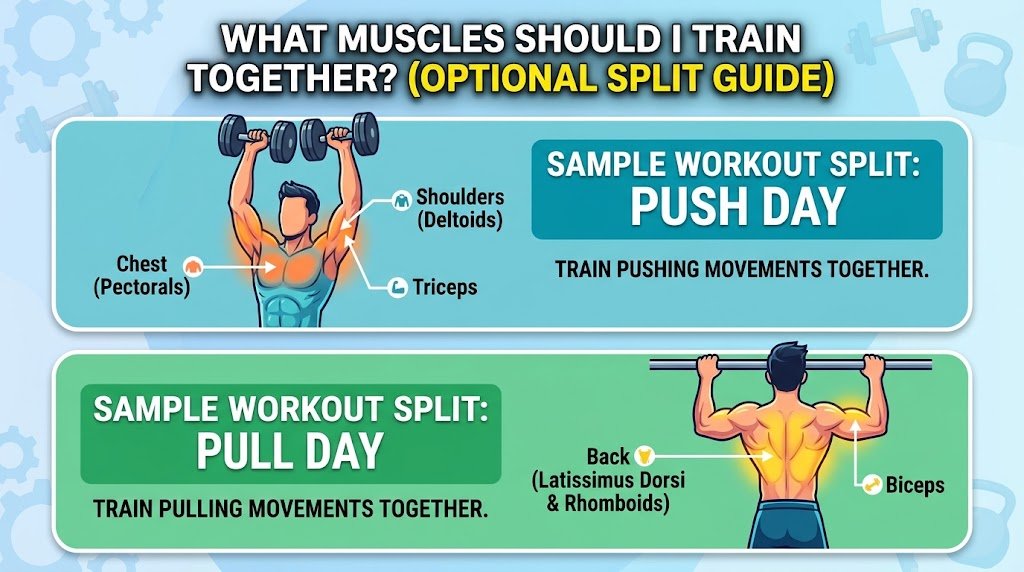
Your chest and triceps work together during pushing exercises. For example, when you perform a bench press or push-up, your chest helps move the weight while your triceps assist in extending your elbows.
Training these muscles together allows you to complete several related exercises in one session.
Exercises to try:
Bench press or dumbbell chest press
Push-ups
Incline dumbbell press
Triceps pushdowns
Overhead triceps extensions
A useful tip is to perform your main chest exercises first, followed by triceps isolation exercises. Your triceps may already be tired after pressing movements, so adjust the weight and repetitions as needed.
2. Back and Biceps
Your back and biceps are another common pairing because both are involved in pulling movements. Exercises such as rows and lat pulldowns train your back while also requiring your biceps to help bend your elbows.
Exercises to try:
Lat pulldowns
Seated cable rows
One-arm dumbbell rows
Dumbbell biceps curls
Hammer curls
Start with your larger back exercises before moving to curls. This helps you focus on movements that involve more muscles and generally require greater effort.
3. Shoulders and Triceps
Shoulders and triceps can work well together in a push-focused workout. Your triceps assist with overhead pressing, while your shoulder muscles help lift and control the weight.
Exercises to try:
Dumbbell shoulder presses
Lateral raises
Front raises, if appropriate for your routine
Triceps pushdowns
Overhead triceps extensions
Remember that your front shoulders and triceps may already receive substantial work during chest exercises. Plan your weekly sessions so these muscles have adequate recovery time.
4. Legs and Glutes
Your legs and glutes work together during movements such as squats, lunges, and step-ups. Training them in the same session is a convenient way to strengthen your lower body.
Exercises to try:
Squats or chair squats
Romanian deadlifts
Reverse lunges
Glute bridges
Step-ups
Calf raises
Choose exercises that match your current ability. Beginners can start with bodyweight movements before gradually adding resistance. Good technique and controlled movement are more important than lifting heavy weights too soon.
5. Core and Other Muscle Groups
Your core muscles help stabilize your body during many exercises, including squats, rows, and overhead presses. You can train your core at the end of a full-body session or pair it with another muscle group.
Exercises to try:
Planks
Dead bugs
Bird dogs
Pallof presses
You do not necessarily need a separate abdominal workout every day. Focus on consistent, controlled core training and allow yourself to recover between challenging sessions.
Which Muscle Groups Should Beginners Train Together?
If you are new to strength training, a full-body workout is often a practical starting point. Instead of dedicating an entire day to one muscle group, you train several major muscle groups during each session.
A beginner full-body workout might include:
A squat or other leg exercise
A chest press or push-up
A row or pulldown
A hip-hinge or glute exercise
A core stability exercise
Start with a manageable number of sets and choose weights that allow you to maintain proper form. Two or three full-body sessions per week can be a reasonable starting schedule for many beginners, with rest days between challenging sessions.
As your strength and confidence improve, you can adjust your exercises, resistance, and weekly schedule.
How to Organize Your Weekly Workout Split
Your workout split determines which muscles you train on each day. The right choice depends largely on how many days you can realistically exercise.
| Training schedule | Suggested approach |
|---|---|
| 2 days per week | Full-body workouts |
| 3 days per week | Full-body workouts with alternating exercises |
| 4 days per week | Upper body and lower body split |
| 5 days per week | Push, pull, legs, plus two sessions based on your goals |
A push-pull-legs split groups pushing muscles, pulling muscles, and lower-body muscles into separate sessions. An upper-lower split separates upper-body training from lower-body training.
Neither approach is automatically better than the other. Consistency, suitable training volume, good technique, and recovery have a major influence on your progress.
How Often Should You Train Each Muscle Group?
Many adults can benefit from training each major muscle group about twice per week, although the ideal frequency depends on experience, workout intensity, and recovery.
Allow sufficient recovery between hard sessions for the same muscles. You may need more time if you are new to exercise, have performed an unusually demanding workout, or are experiencing significant soreness.
Keep these principles in mind:
Progress gradually: Increase resistance or repetitions as your strength improves.
Use good technique: Do not sacrifice movement quality to lift heavier weights.
Get enough rest: Sleep and rest days support recovery.
Eat well: Adequate protein, balanced meals, and enough overall energy help support muscle growth.
Adjust when necessary: Reduce the workload if persistent soreness or fatigue affects your performance.
If you have an injury, ongoing pain, or a health concern that affects exercise, seek appropriate professional guidance before changing your routine.
Build a Workout Plan That Fits Your Goals in Kyle, TX
The best muscle-group combination is the one that fits your goals, schedule, and current fitness level. A busy professional may benefit from three efficient full-body sessions each week, while someone with more training experience may prefer an upper-lower or push-pull-legs split.
At Kyle TX Personal Training, you can work toward your goals with a training approach tailored to your needs and abilities. Whether you want to build muscle, improve strength, lose body fat, or establish a consistent exercise routine, having a structured plan can help you train with purpose.
Frequently Asked Questions
Can I train chest and biceps together?
Yes. Chest and biceps can be trained in the same session. They have different primary roles in most exercises, so this pairing can work well if it fits your weekly plan.
Is it better to train one muscle group per day?
Not necessarily. Training one muscle group per day can work for some experienced lifters, but it is not required for muscle growth. Full-body and upper-lower routines can be more practical for people who have fewer days available to exercise.
Can I train the same muscle two days in a row?
You can perform light activity on consecutive days, but challenging the same muscles hard on back-to-back days may limit recovery. Consider the intensity of each session and allow adequate rest between demanding workouts.
What is the best workout split for building muscle?
The best split is one you can follow consistently while training all major muscle groups with appropriate effort and recovery. Full-body, upper-lower, and push-pull-legs routines can all support muscle growth when programmed well.
How long should I rest between workouts for the same muscle group?
Many people benefit from roughly 48 hours between challenging sessions for the same muscle group, but recovery needs vary. Training volume, intensity, sleep, experience, and soreness all affect how much rest you need.
Start Training With a Plan
Choosing the right muscle groups to train together can help you build a more organized and sustainable fitness routine. Begin with a schedule that matches your experience, focus on proper technique, and increase the challenge gradually as you get stronger.
Ready to make your workouts more effective? Contact Kyle TX Personal Training to explore a personalized training plan that fits your schedule, fitness level, and goals.